
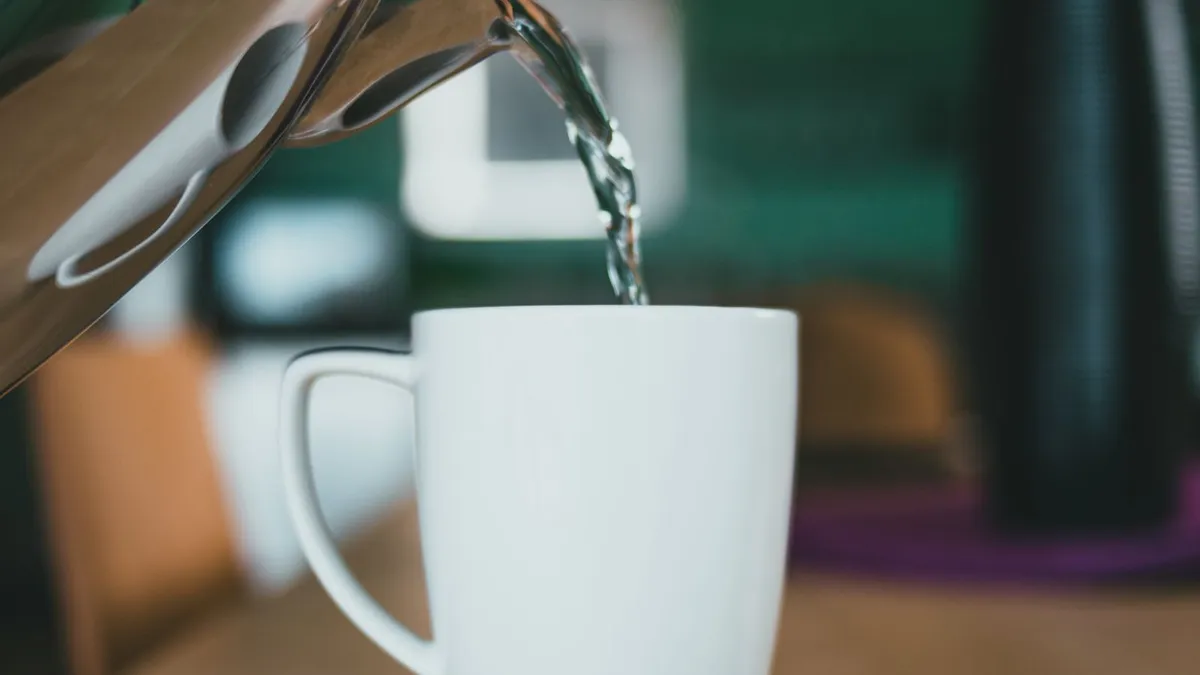
Most people boil the kettle and pour. And the coffee's fine. But temperature is one of the easiest things you can control, and getting it into the right range often makes a noticeable difference in how balanced the cup tastes.
PourOverPro is reader-supported. As an Amazon Associate we earn from qualifying purchases. Product details come from each maker's specs and the Amazon listing; we don't lab-test products.
Start in the SCA's commonly cited 195-205°F (90-96°C) range. Without a thermometer, bring water to a boil and let it rest briefly (around 30 seconds is a common rule of thumb). Try the hotter end for light roasts and a little cooler for dark roasts. If the cup tastes sour, try hotter water or a finer grind; if bitter, cooler or coarser, one change at a time.
Here's the short explanation. Hot water pulls flavor out of coffee faster; cooler water does it more slowly. Too cool and you don't get enough out, so the cup tastes sour and thin. Too hot for that coffee and you get too much, so it tastes bitter and harsh. The goal is the range in between.
The Commonly Cited Range: 195-205°F (90-96°C)
The Specialty Coffee Association cites 195-205°F (90-96°C) as the brewing range. For most hot brewing methods, water in that range does a good job. Treat it as a starting point, then adjust for the coffee in front of you and how it tastes.
Even inside that range, there's room to move. The low end is gentler; the high end is more aggressive. A little sour? Try sliding hotter. A little harsh? Try sliding cooler. Those are first moves, not diagnoses: grind, roast, water and pouring technique can push the cup the same way.
What Happens When Water Is Too Hot
Over-extraction. Think bitter, harsh or dry, with an aftertaste that hangs around longer than you'd like.
You'll notice it most with darker roasts, which give up their flavor easily. Plenty of people find dark roasts taste smoother brewed a bit below boiling. Lighter roasts are the opposite: generally denser and harder to extract, so they often like the hotter end.
What Happens When Water Is Too Cool
Under-extraction. The coffee comes out sour, thin and sharp, and the sweetness never shows up.
One thing worth knowing: acidity isn't automatically a problem. Bright, lively acidity is part of what makes a lot of coffees interesting. What you're watching for is the sour, tart, unfinished kind. If the cup tastes sour and weak, check temperature and grind first, one at a time.
Different Methods, Different Starting Points
Pour over: Start around 200-205°F, especially for light roasts. The water doesn't hang around long, so a little extra heat helps it do its job on the way through.
AeroPress: The rebel. AeroPress's own instructions call for 185°F (85°C), or boiling water if you can't set a temperature, and many published AeroPress recipes go cooler still, sometimes as low as about 175°F (80°C). The fine grind, immersion and pressure already make extraction efficient. Play around.
French press: Water just off the boil, within the 195-205°F range, is the usual starting point for a full immersion brew.
Cold brew: Skips heat entirely. It uses cold or room-temperature water and a long steep (roughly 12-24 hours) instead. See our cold brew guide.
Moka pot: Harder to control, since the temperature climbs as the pot heats. A lot of people start with hot water in the base so the coffee spends less time on the stove.
How to Judge Temperature Without a Thermometer
Boil the water, take it off the heat, and let it sit briefly before you pour. Around 30 seconds is a common household rule of thumb, not a measured method: how fast water cools depends on your kettle, how full it is, how chilly your kitchen is and your altitude, so you won't know the actual temperature.
It isn't precise, but this is breakfast, not chemistry class. A few degrees off is unlikely to ruin a cup. Way off can.
If you'd rather know than guess, a simple kitchen thermometer does the trick, or get a kettle that lets you set the temperature.
Does Altitude Matter?
It does. The higher you live, the lower the air pressure, and the lower the temperature water boils at. At sea level, water boils at 212°F (100°C). Per the USDA, the boiling point drops by just under 1°F for every 500 feet you climb; at 7,500 feet, water boils at about 198°F.
Up in the mountains, water straight off the boil may already be in or near the brewing range, and you can skip the wait. At sea level, a short rest after boiling helps. Live somewhere high and your coffee tastes sour? You may simply not be able to get the water any hotter. A slightly finer grind can make up for it.
Is Boiling Water Ever Fine?
Sometimes. Very light roasts are dense and can be stubborn, and some people brew them with water right off the boil. Besides, by the time water hits the grounds in a pour over, it's already cooled a little.
Medium and dark roasts are a different story. Boiling water is more likely to drag out harsh, bitter flavors. The rule of thumb: hotter for light, a bit cooler for dark, and let your taste buds have the final say.
Taste Diagnostic: What to Try Next
Use this as a list of first experiments, not a verdict. Keep your dose and water weight the same, change one thing, and taste again. The SCA Coffee Brewing Control Chart treats extraction (sour vs. bitter) and strength (weak vs. strong) as separate things, so the fixes differ.
| What you taste | Likely cause | Next single change to try |
|---|---|---|
| Sour, sharp, thin; brew ran fast | Under-extraction | Grind a step finer, or raise temperature a few degrees within range |
| Bitter, harsh, drying; brew ran slow | Over-extraction | Grind a step coarser, or lower temperature a few degrees |
| Balanced but watery | Strength too low | Use a little more coffee for the same water |
| Balanced but heavy or intense | Strength too high | Use a little less coffee, or add water to the cup |
| Sour and bitter at once | Uneven extraction (inconsistent grind, channeling) | Check grind evenness and pour more gently and evenly before changing temperature |
| Bright but pleasant, fruity | Probably the coffee itself | Nothing; many light roasts are meant to taste this way |
Water Temperature and Grind Size Together
These two are tangled together. Finer grinds extract faster; coarser grinds, slower. Change the grind and the extraction changes, even if the water temperature hasn't budged.
Pick a temperature and hold it steady while you dial in the grind. Then, if you still need to, fine-tune the temperature. Change both at once and you'll never know which one helped.
The Equipment: Do You Need a Temperature-Control Kettle?
Need? No. A regular kettle plus a thermometer, or the boil-and-rest trick, works fine. But if you brew every morning and want the same cup every time, a variable-temperature gooseneck lets you set a number and pour with control. It's one less thing to think about before you're fully awake.

Fellow Stagg EKG Pro
- Electric gooseneck kettle, 0.9 L
- To-the-degree temperature control
- High-resolution LCD and built-in brew timer
The Fellow Stagg EKG Pro lets you set the temperature to the degree and has a built-in brew timer, per the listing.
OXO Brew Pour-Over Gooseneck Electric Kettle
- Adjustable from 104-212°F in 1° steps
- Holds temperature for 30 minutes
- Built-in count-up brew timer; cordless lift-off base with auto shut-off
According to its listing, the OXO Brew Pour-Over Gooseneck Kettle adjusts in 1° steps, holds temperature for 30 minutes, and has a built-in timer. For more options, see our gooseneck kettle guide.
What About the Water Itself?
Temperature isn't the only water variable. In a Specialty Coffee Association article, coffee researcher Marco Wellinger notes reports of "underextracted flavor" when total hardness is below about 40 ppm and "overextracted flavor" above about 250 ppm. He also argues that alkalinity matters more than pH for how acidic a cup tastes.
In practice, very soft water such as plain reverse osmosis water sits at the low end of that range. If you filter with reverse osmosis, our sister site PureFlow Lab explains remineralization filters, which add some calcium and magnesium back after the membrane.
Water Temperature for Coffee: If You Remember One Thing
Temperature is one of the easiest ways to make your coffee more consistent. Start within 195-205°F (90-96°C), go hotter for light roasts and a little cooler for dark ones, and let your taste guide you from there. A thermometer or a variable-temperature kettle makes it easy to repeat what works.