
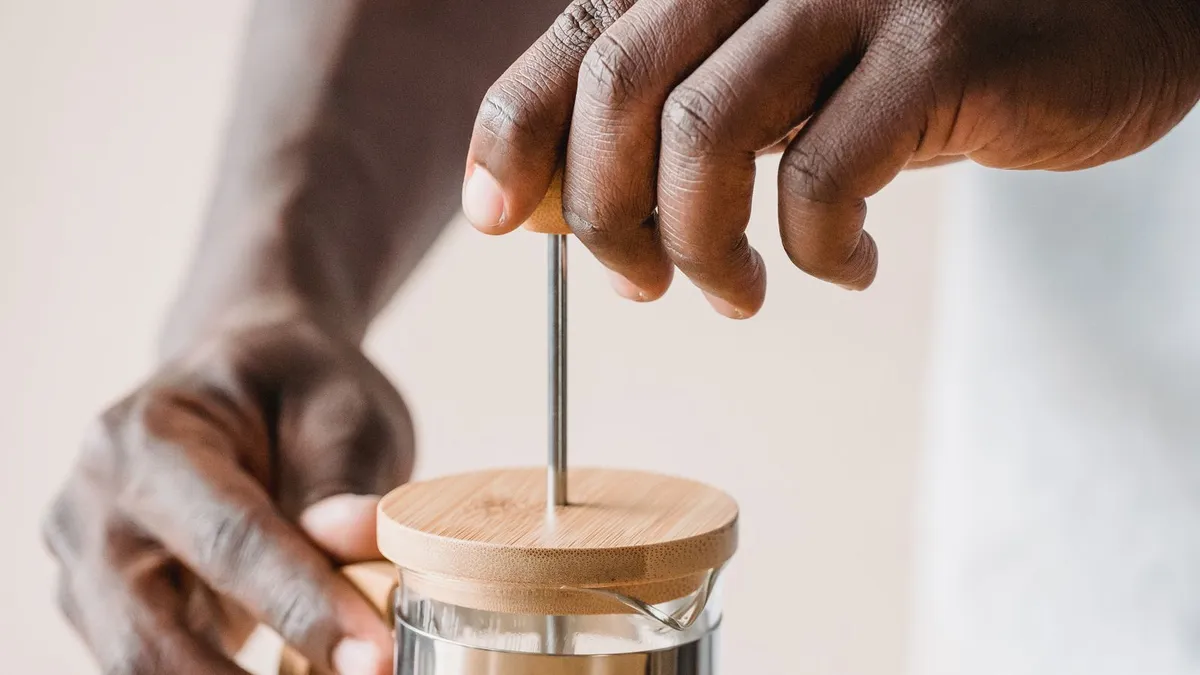
French press has a bit of a reputation, and it's mostly earned by people making it badly. Muddy, bitter French press is everywhere. So is clean, rich, really good French press. The difference is usually technique, not the pot.
PourOverPro is reader-supported. As an Amazon Associate we earn from qualifying purchases. Product details come from each maker's specs and the Amazon listing; we don't lab-test products.
Start with a coarse grind, about 1:15 by weight (roughly 60 g of coffee to 900 g of water in a 34 oz press), water just off the boil and a 4-minute steep. Break the crust, skim, optionally let the fines settle, then press gently and pour slowly. If it's bitter or muddy, try coarser or shorter; if it's weak, try finer or more coffee.
First, how to make a cup that doesn't taste like sludge. Then what usually causes the mud, the skim-and-settle trick James Hoffmann popularized, how to pick a press, and how to keep it clean.
The Basic Technique
French press is immersion brewing: the grounds sit in hot water, and a metal mesh screen holds them back at the end. No paper filter means some fine particles and oils make it into your cup. That's where the rich body comes from. It's also where the sludge comes from when the technique slips.
1. Grind Coarse
This is where most bad French press starts. A medium or medium-fine grind gives up its flavor too fast over a four-minute steep, and the small bits slip through the mesh. Hello, bitterness and mud. Go coarse instead, roughly like coarse sea salt.
Bigger pieces release flavor more slowly, which is exactly what you want when the coffee's going to sit in water for a while.
2. Use a Sensible Ratio
Start somewhere around 1:15 to 1:17, coffee to water, by weight. At 1:15, 500 g of water takes about 33 g of coffee.
No scale? Our coffee-to-water ratio guide has volume approximations. They'll get you close, but weighing is more consistent.
3. Bloom Briefly
Use water just off the boil, within the 195-205°F (90-96°C) range the Specialty Coffee Association cites. Pour just enough to wet all the grounds, roughly twice the coffee's weight, and wait 30-45 seconds. A crust forms on top as CO2 bubbles out.
4. Add the Rest of the Water
Pour in the rest, leaving a little room below the rim. A gentle stir takes care of any dry clumps.
5. Steep for About 4 Minutes
Four minutes is the usual baseline. Go a little shorter for a lighter cup or a little longer for a stronger one. If you're tempted to make big changes to time, change the grind first.
6. Break the Crust and Skim
At four minutes, stir the crust so most of the grounds sink. Then take a spoon and skim off the foam and floating bits. It feels fussy. It's also a big chunk of the fine stuff that makes French press muddy.
7. Pour Gently and Leave the Last Bit
Press the plunger down gently, no forcing, then pour slowly. Leave the last bit in the pot. That's where the sediment settles, and nobody wants that final gritty sip.
Why Your French Press Tastes Muddy
Grind Too Fine
The usual suspect. Fine grounds over-extract and slip through the mesh. Go coarser.
Grounds in Your Cup
Pressing hard or pouring fast shoves fines through the screen. Skim, press gently, pour slowly, and leave the bottom of the pot behind.
Water or Beans
Immersion brewing shows off whatever you put in, good or bad. If your tap water tastes off, use filtered. Use freshly roasted beans, and grind just before brewing.
A Dirty Press
Old coffee oil clinging to the mesh and carafe can make fresh coffee taste stale. More on cleaning below.
The James Hoffmann Technique
Coffee author and YouTuber James Hoffmann published a French press method that a lot of people now swear by. The whole idea is patience: let gravity pull the fines down instead of trying to force them out by pressing hard.
- Brew as usual for about 4 minutes.
- Break the crust and skim off the foam and floating grounds.
- Wait several more minutes (his method suggests 5 or more) so the fine particles sink to the bottom.
- Lower the plunger only until the screen reaches the surface of the coffee, not down into the grounds.
- Pour slowly, leaving the sediment behind.
Since the screen never plows through the grounds, less sediment gets stirred up and pushed into your cup, and the result is typically cleaner. Yes, it takes longer. French press was never the speedy option anyway.
Glass vs Stainless Steel Presses
Glass: You can watch the brew, and it's easy to clean. But it breaks if you drop it, and a single-wall glass carafe loses heat faster than an insulated one.
Stainless steel: Shrugs off drops better. Double-wall insulated models are generally better at keeping coffee hot. The downside is that you can't see inside.
Drink it right away? Glass is fine. Want the pot to stay warm through a slow weekend breakfast? Look at insulated stainless. Either way, pour off what you won't drink soon. Coffee left sitting on the grounds keeps extracting and can turn bitter.
French Presses to Consider
Bodum Chambord (Glass)

Bodum Chambord French Press, 34 oz
- Borosilicate glass carafe, polished stainless steel frame
- Made in Portugal
- Not for stovetop use
The Bodum Chambord is the French press most people picture when they hear the words. The 34 oz size makes enough for two or more cups. Per the listing, the carafe is borosilicate glass in a polished stainless frame, and it's not for stovetop use.
ESPRO P3 (Glass, Dual Micro-Filter)
ESPRO P3 French Press, 32 oz
- Dual-layer micro-filter
- 10 paper filters included
- Borosilicate glass that's 40% thicker, per ESPRO; twist-lock latch
If grit in the cup is what drives you nuts, the ESPRO P3 is designed around it. Instead of a single mesh screen it uses a dual-layer micro-filter, and the listing says it comes with 10 paper filters for an even cleaner cup. ESPRO says its glass is 40% thicker.
How to Choose
Want the classic look and a simple mesh filter? The Chambord. Care most about a cleaner, lower-sediment cup? The ESPRO P3. Both are glass, so treat them kindly.
Cleaning Your French Press
Coffee oil residue is the enemy. After brewing, dump the grounds (compost or trash, not the sink drain; your plumbing will thank you) and rinse the carafe and plunger while they're still warm, before the oils dry on.
Day to day, hot water and a brush usually do it. Every so often, take the filter assembly apart (if your press allows it) and wash each piece with a little dish soap. Check your maker's care instructions.
Clean press, cleaner coffee. Not complicated.
Troubleshooting
Coffee Tastes Bitter and Muddy
Usually a grind that's too fine, a steep that's too long, or a press overdue for a proper clean. Go coarser, shorten the steep a little, or try the skim-and-settle method above.
Coffee Tastes Weak
Either the grind is too coarse or there's not enough coffee. Use more (say, move from 1:17 toward 1:15), grind a little finer, or steep a bit longer.
Coffee Cools Down Too Fast
Warm the press with hot water first, then dump it. Still cooling too fast? An insulated stainless press helps, or pour into a preheated mug or thermal carafe.
A Simple French Press Recipe
For a 34 oz press, as a starting point:
- Preheat the press with hot water, then dump it out
- Add about 60 g of coarse ground coffee
- Pour about 120 g of water just off the boil to wet the grounds
- Wait 30-45 seconds for the bloom
- Add water to about 900 g total (roughly 1:15)
- Steep 4 minutes
- Break the crust and skim off the foam and floating grounds
- Optional: wait several more minutes to let the fines settle
- Lower the plunger gently, just to the surface of the coffee
- Pour slowly, leaving the last bit behind
Then adjust, one change at a time: coarser or shorter if it's bitter, finer or more coffee if it's weak.
French Press Coffee: The Short Version
People call French press a beginner's brewer, and it is easy. But a clean cup takes a little care with grind, time and pouring. Get those right and you get coffee with more body and richness than paper-filtered methods typically manage. Grind coarse, steep about 4 minutes, skim, let it settle, pour gently.