
There's no single best way to brew coffee. Some people care about speed, some about flavor, and some just need caffeine in their body before they find their car keys. Instead of crowning a winner, here's how each major method works, what it typically tastes like, how much effort it takes, and who it's really for.
PourOverPro is reader-supported. As an Amazon Associate we earn from qualifying purchases. Product details come from each maker's specs and the Amazon listing; we don't lab-test products.
- Care about flavor and want to learn how extraction works: pour over.
- Least effort: French press or a good drip machine.
- Forgiving and portable: AeroPress.
- Strong coffee on the stove: moka pot. Milk drinks: espresso. Iced coffee all week: cold brew.
One caveat: the taste notes below describe what each method typically does. Your beans, grind and recipe will push things around.
Pour Over: Clean and Controllable
You pour hot water over ground coffee in a paper filter and let it drain into your cup. That's the whole method. The paper traps most of the oils and fine sediment, which is why pour over is known for a clean cup. And since you're the one deciding the pour speed, water temperature and brew time, you're steering the result the whole way.

Hario V60 Plastic Dripper 02
- Lightweight plastic cone dripper
- Size 02 brews 1-4 cups, per Hario
- Uses V60 02 cone filters
Once you find a recipe you like, it's easy to repeat. A common starting point is water in the 195-205°F (90-96°C) range the Specialty Coffee Association cites, a medium-fine grind, and a ratio of about 1:16 coffee to water. An inexpensive dripper like the Hario V60 Plastic 02 is all you need to start.
Typical flavor: Clean, bright, highlights acidity and origin character
Effort level: Moderate; you're pouring and paying attention for a few minutes
Best for: People who care about flavor clarity and enjoy a hands-on routine
The Chemex, Hario V60 and Kalita Wave each have their own personality; see our pour over coffee makers guide. Underneath, they all run on the same basics: hot water, ground coffee, a filter and timing.
French Press: Full Body, Low Barrier
French press is immersion brewing. Coarse grounds sit right in the hot water, then you press a metal mesh filter down to trap them at the bottom. No paper means more of the oils and fine particles land in your cup.
Bodum Chambord French Press, 34 oz
- Borosilicate glass carafe with polished stainless frame
- Made in Portugal
- Not for stovetop use
That's why French press typically tastes heavier and fuller-bodied. The technique fits on a sticky note: coarse grounds, hot water, about four minutes, press. There's not much to get wrong, and for a lot of people that's the whole point. The Bodum Chambord is the classic example.
Typical flavor: Full-bodied, rich, some sediment
Effort level: Low; mostly waiting
Best for: People who want simplicity and don't mind a little sediment
For technique details, see our French press guide.
AeroPress: Immersion Plus Pressure
The AeroPress looks like an oversized syringe. You steep medium-fine coffee in the chamber, then press the brew through a filter. Steeping plus pressure gets the flavor out efficiently, and the cup is typically cleaner than French press with more body than many pour overs.
AeroPress Original
- Immersion plus pressure with micro-filtration
- Works with paper or metal filters
- Compact and shatterproof
It's forgiving, too. Nudge the grind, timing or temperature a little and you'll usually still get a good cup, and setup and cleanup take almost no time. The AeroPress Original is compact and shatterproof, according to AeroPress, which makes it a common travel pick.
Typical flavor: Clean but full-bodied, balanced
Effort level: Low; forgiving
Best for: Travel, camping, or anyone who wants good coffee without fuss
The big limitation: it makes one cup at a time, so it's not the thing for a houseful of guests. See the full AeroPress guide for recipes.
Drip Coffee Machine: Push-Button Convenience
A drip machine heats water and spreads it over grounds in a paper filter. Whether the coffee is good depends mostly on two things: does the machine get the water hot enough, and does it wet the grounds evenly? Machines that run too cool or rush the brew tend to make thin, sour coffee.
Shopping for one? The Specialty Coffee Association runs a certification program for home brewers that checks things like brew temperature and time, which is a handy shortcut. And whatever machine you have, grinding fresh and using a sensible ratio can make a noticeable difference.
Typical flavor: Depends on the machine; generally clean and balanced
Effort level: Minimal; press a button
Best for: Brewing for groups, offices, and anyone prioritizing convenience
Espresso: High Skill, High Reward
Espresso forces hot water through finely ground, tamped coffee under high pressure (around 9 bar is the commonly cited target). Shots take roughly 25-30 seconds and produce a concentrated, intense coffee with crema.
It's demanding. Grind too coarse and shots run fast and taste thin; too fine and they can choke and taste bitter. Tamp unevenly and water finds a shortcut through the puck (that's called channeling). Tiny changes show up in the cup. The reward is a distinctive, concentrated drink, plus the base for lattes, cappuccinos and flat whites.
Typical flavor: Intense, concentrated, syrupy
Effort level: High; requires practice and a capable grinder
Best for: People who enjoy the process and want milk drinks
If all you want is good black coffee, espresso is the long way around. A pour over or AeroPress will get you there with far less effort.
Cold Brew: Low Effort, Different Flavor
Cold brew steeps coarse grounds in cold or room-temperature water for roughly 12-24 hours, then you strain them out. Cold water pulls flavor out differently than hot, and cold brew is typically described as smooth, sweet and low in perceived acidity.
The downside is time. You have to plan a day ahead. Some people love the mellow flavor; others find it flat next to hot coffee.
Typical flavor: Smooth, sweet, mellow
Effort level: Minimal; mostly waiting
Best for: Summer, batch brewing, iced coffee drinkers
See our cold brew guide for ratios and gear.
Moka Pot: Strong Stovetop Coffee
A moka pot has three parts: a bottom chamber for water, a funnel basket for coffee, and a top chamber that collects the brew. As the water heats, steam pressure in the bottom pushes hot water up through the grounds and into the top. That pressure is far lower than an espresso machine's, so it isn't true espresso. What it does make is strong, concentrated coffee.
Bialetti Moka Express, 3-Cup
- Aluminum stovetop brewer, made in Italy (per the listing)
- Safety valve; rinse with water only, no dishwasher
- Works on induction only with Bialetti's adapter plate
Use a grind a bit coarser than espresso, fill the basket without tamping, and pull it off the heat as soon as it starts to sputter. Leave it on and you're flirting with a burnt taste. The Bialetti Moka Express is the original design; note that Bialetti says to rinse it with water only.
Typical flavor: Strong, concentrated, bold
Effort level: Low; watch the stove
Best for: People who want strong coffee without an espresso machine
Siphon Coffee: Brewing as Theater
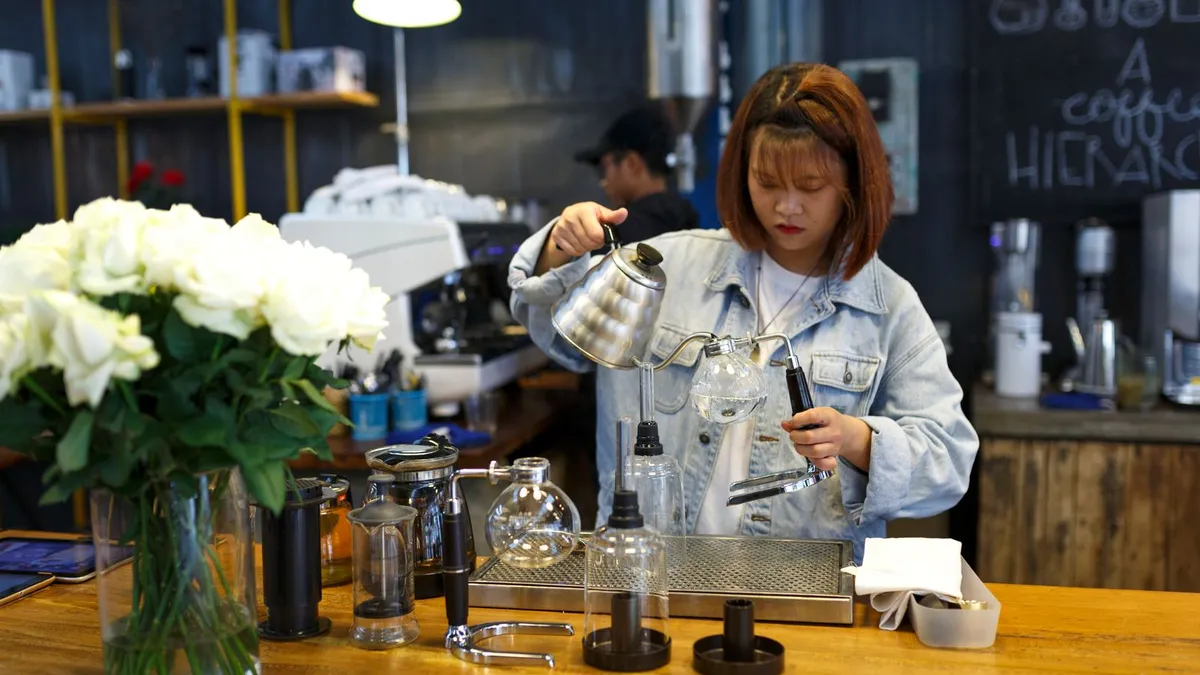
A siphon (vacuum pot) has two chambers. Heat the lower one and water rises into the top, where it steeps with the coffee. Take the heat away, the lower chamber cools, pressure drops, and the brewed coffee gets sucked back down through a filter (usually cloth, sometimes paper or metal). It looks like a science fair project, in a good way.
The coffee is typically clean and aromatic. But siphons are fragile, need a heat source, and take more handling than a pour over for a broadly similar cup. A lot of the appeal is the show.
Typical flavor: Clean, bright, aromatic
Effort level: Moderate; careful handling required
Best for: Coffee enthusiasts who enjoy the ritual
Quick Comparison Table
| Method | Typical Flavor | Effort | Typical Time |
|---|---|---|---|
| Pour Over | Clean, bright | Moderate | 3-5 min |
| French Press | Full-bodied, rich | Low | 4-5 min |
| AeroPress | Balanced, clean | Low | 2-4 min |
| Drip Machine | Balanced | Minimal | Varies by machine |
| Espresso | Intense, concentrated | High | Under 1 min per shot |
| Cold Brew | Smooth, mellow | Minimal (waiting) | 12-24 hrs |
| Moka Pot | Strong, bold | Low | About 5 min |
| Siphon | Clean, aromatic | Moderate | 5-10 min |
Which One Should You Choose?
Starting from zero and care about flavor? Go with pour over. You can actually watch it work: you see the water flow, and when you change the grind or the water temperature, you taste the difference in the very next cup. Everything you learn carries over to every other method.
It's also easy to get into. A basic dripper, filters, a kettle and a burr grinder will make very good coffee. No planning a day ahead, no espresso learning curve.
But if flavor isn't your top priority, here's the cheat sheet:
- Want the least effort: French press or a good drip machine.
- Want forgiving and portable: AeroPress.
- Want strong coffee on the stove: Moka pot.
- Want milk drinks: Espresso.
- Want iced coffee all week: Cold brew.
The best method is the one that fits your mornings and that you'll actually keep using. A fancy brewer gathering dust makes no coffee at all.
What to remember
Every method earns its spot. Pour over is typically the clearest and most controllable, French press the simplest and fullest-bodied, and the AeroPress the most forgiving and portable. If you're new and care most about flavor, start with pour over. What it teaches you works everywhere else.
Ready to give pour over a shot? Read our complete guide to making pour over coffee and our guide to the best pour over coffee makers. Torn between the two most common manual methods? See pour over vs French press.