
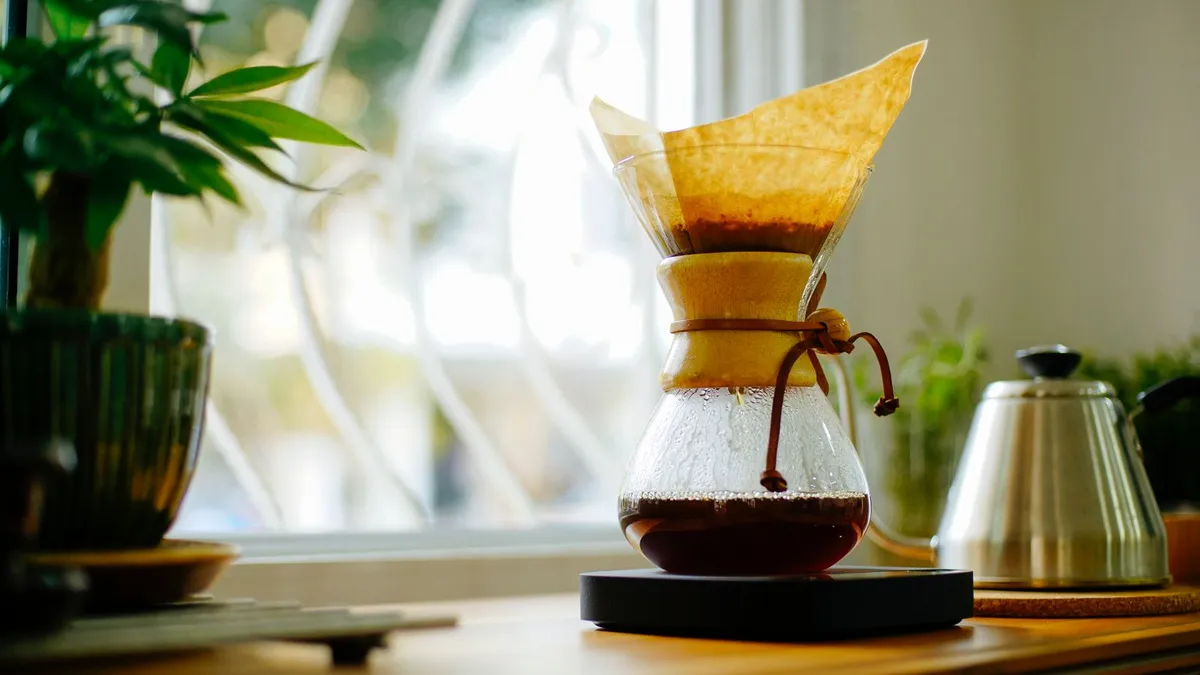
Line a few pour over drippers up on a shelf and they look like the same idea in different colors: grounds go in, water goes over, coffee comes out. The details are where they split. Cone or flat bottom, one hole or two, which filter it takes, and whether it drains straight through or steeps first all change how forgiving the brewer is and what kind of cup it tends to make. Below are seven of them, described from each maker's specs and the current Amazon listing, with a plain take on who each one suits.
PourOverPro is reader-supported. As an Amazon Associate we earn from qualifying purchases. Product details come from each maker's specs and the Amazon listing; we don't lab-test products.
- Learning pour over: Hario V60 02 (plastic or ceramic).
- Consistency with less technique: Kalita Wave 185, or the Clever Dripper if you'd rather not pour at all.
- Brewing for two or more: Chemex 6-Cup, plus Chemex bonded filters.
- Supermarket #2 filters: Bee House or Melitta cone. Stainless and insulated: Fellow Stagg [X].
How to Choose a Pour Over Dripper
- Shape. With a cone and one big hole (like the V60), the flow rate is mostly up to your grind and your pour. Flat-bottom drippers (like the Kalita Wave) keep the coffee bed level and are generally considered more forgiving.
- Filters. Some drippers take the standard #2 cone filters you'll find in most supermarkets. Others want their own brand. Think about the filters you'll be buying for years, not just the dripper you're buying today.
- Material. Plastic is light and hard to break. Ceramic and glass look nicer but can chip or break. Double-wall stainless is insulated.
- Batch size. Single-cup drippers are for one. Making coffee for two or more? Look at a Chemex or the Kalita Wave 185.
- Technique. No interest in learning to pour? An immersion-plus-drawdown brewer like the Clever Dripper is the most hands-off option here.
Hario V60: The Classic Cone

Hario V60 Plastic Dripper, Size 02
- Size 02 brews 1-4 cups, per Hario
- Lightweight plastic body
- Pairs with Hario V60 02 paper filters (sold separately)
Hario V60 Ceramic Dripper, Size 02
- Arita-yaki ceramic, handmade in Japan
- Spiral ribs on the inner wall
- Single large hole at the bottom
The Hario V60 is a cone with spiral ribs and one large hole at the bottom. With an opening that big, your grind and your pour set the pace. Grind finer or pour slower and the brew slows down; grind coarser or pour faster and it speeds up. That's why people say the V60 rewards technique. It also means it'll tell on you.
The V60 Plastic 02 is lightweight, and per Hario, the 02 size brews 1-4 cups. The V60 Ceramic 02 is Arita-yaki ceramic, handmade in Japan. Both take V60 02 paper filters, like Hario's white 100-count pack, which are oxygen-bleached per the listing.
Hario V60 02 Paper Filters, White, 100 Count
- Sized for the V60 02 dripper
- White, oxygen-bleached paper
- 100 filters per pack
If you want the most widely used pour over cone and don't mind practicing, this is the one to learn on. Just know it's generally considered less forgiving than a flat-bottom or immersion brewer when your pour gets sloppy.
Chemex 6-Cup Classic: For Brewing More Than One Cup
Chemex 6-Cup Classic Pour-Over Coffee Maker
- Non-porous borosilicate glass
- Chemex counts 5 oz as one cup
- Uses Chemex bonded filters (FP-1, FC-100, FS-100, FSU-100); filters not included
The Chemex 6-Cup Classic is made of non-porous borosilicate glass. One quirk to know before you buy: Chemex counts 5 oz as a cup, so "6-cup" means six Chemex cups, not six big mugs.
It uses Chemex's own bonded filters, which aren't included. Chemex says they're "20-30% thicker than other filters." Thicker paper is generally linked with a cleaner cup, since it holds back more oils and fine particles. Some people love that. Others find it a bit light in body.
Chemex Bonded Filters, Natural Squares, 2 x 100
- Made in USA, per Chemex
- "20-30% thicker than other filters," per Chemex
- Fit all Chemex brewers except the CM-1, CM-1C and CM-1GH
It's a natural fit if you regularly brew for two or more and like a very clean cup. The downsides: it's glass, and you're committed to Chemex bonded filters.
Kalita Wave 185: Flat-Bottom Consistency
Kalita Wave 185 Glass Dripper
- Flat-bottom design; makes 16-26 oz
- Uses Kalita Wave filters
- Dripping area 2" wide; base 4" across
The Kalita Wave 185 has a flat bottom, which keeps the coffee bed level as it drains. Flat-bottom drippers are widely regarded as more forgiving of pouring technique than single-hole cones, which makes the Wave an easy everyday brewer. Per the listing it makes 16-26 oz, with a dripping area 2" wide and a base 4" across, so measure your mug or server before you order.
Pick it if you want good coffee every morning without turning your pour into a hobby. It takes Kalita Wave filters rather than standard cones, and this version is glass.
Fellow Stagg [X]: Insulated Stainless Steel
Fellow Stagg [X] Pour-Over Dripper
- 10 oz capacity
- Stainless steel, double-wall vacuum insulated
- Built-in ratio aid; includes 15 filters
The Fellow Stagg [X] is a 10 oz stainless steel dripper with double-wall vacuum insulation, a built-in ratio aid, and 15 filters in the box. And unlike glass or ceramic, it won't shatter if it slips out of a sleepy hand.
For single cups and a dripper that can take a knock, it's a good call, and the ratio guide is a nice touch. But 10 oz is one cup, full stop, and it usually costs more than plastic or ceramic cones.
Bee House: Standard Filters, Handy Peek Hole
ZERO JAPAN Bee House Ceramic Dripper (Jeans Blue)
- Ceramic, handcrafted in Mino, Japan
- Two drip holes plus a peek hole to watch your cup
- Takes #2 cone filters; 3.5" base; dishwasher and microwave safe
The Bee House dripper is a ceramic dripper made in Mino, Japan. It has two holes at the bottom and a peek hole, so you can see how full your cup is getting without lifting anything. It takes standard #2 cone filters from most supermarkets, and the listing says it's dishwasher and microwave safe.
It's a nice pick if you want ceramic, easy-to-find filters, and a base (3.5") that sits on a range of mugs. Like any ceramic, it can chip or break if dropped.
In Oct 2026 the Bee House listing we used went out of stock, so the links now point to another listing for the same dripper (in Jeans Blue). If you'd rather have a different ceramic dripper, the Kalita 102 is another option. It takes Kalita 102 filters rather than #2 cones.
Melitta 1-Cup Pour-Over Cone: The Simplest Start
Melitta 1-Cup Pour-Over Coffee Cone
- Single-cup pour-over cone
- Includes a starter supply of #2 cone filters
The Melitta 1-cup cone is about as simple as pour over gets: set it on a mug, add a filter, add coffee, pour. It comes with a starter supply of #2 cone filters, so you can brew straight out of the box, and replacements are everywhere.
If you just want to find out whether pour over is for you, this is the lowest-effort way to do it. It has fewer documented design features than the others here, but that's not really what it's for.
Clever Coffee Dripper: Immersion Meets Pour Over
Clever Coffee Dripper, Large (Black)
- 18 oz; immersion steep, then paper-filtered drawdown
- Shut-off valve releases when set on a cup (fits cups 1.5" to 3.75" wide)
- BPA-free Tritan plastic; includes 100 filters, coaster and lid
The Clever Coffee Dripper plays by different rules. Coffee and water steep together like a French press, then when you set the dripper on a cup, a shut-off valve opens and the coffee drains through a paper filter. You're not controlling a pour, which makes it one of the most forgiving ways to get a paper-filtered cup.
Great for consistent results with almost no technique. One thing to check: the listing says the valve only opens on cups 1.5" to 3.75" wide, so grab a ruler and look at your mug. (The links now go to the black version; we switched in Oct 2026 when the original listing went out of stock.)
Quick Comparison Table
| Dripper | Style | Material | Filters | Documented Detail | Best For |
|---|---|---|---|---|---|
| Hario V60 02 | Cone, spiral ribs, single hole | Plastic or Arita-yaki ceramic | V60 02 paper | 02 size brews 1-4 cups (Hario) | Learning pour over technique |
| Chemex 6-Cup | Glass brewer | Borosilicate glass | Chemex bonded (not included) | Chemex counts 5 oz as one cup | Brewing for two or more |
| Kalita Wave 185 | Flat bottom | Glass | Kalita Wave filters | Makes 16-26 oz | Consistent daily brewing |
| Fellow Stagg [X] | Dripper with ratio aid | Double-wall stainless steel | 15 included | 10 oz, vacuum insulated | Durable single-cup brewing |
| Bee House | Two-hole dripper | Ceramic (Mino, Japan) | #2 cone | Peek hole, 3.5" base | Easy-to-find filters |
| Melitta 1-Cup | Single-cup cone | Not stated in listing | #2 cone (starter supply included) | Ready to brew out of the box | Simplest start |
| Clever Dripper Large | Immersion plus drawdown | BPA-free plastic | 100 included | 18 oz; fits cups 1.5" to 3.75" | Minimal technique |
The Differences That Matter Most
It's a little awkward to say on a page about drippers, but the dripper often matters less than people expect. Grind quality is widely considered more important. An uneven grind is hard to rescue in any brewer, while a good, even grind helps every dripper on this list do its job.
Fresh beans, water temperature (the SCA's commonly cited range is about 195-205°F / 90-96°C) and your coffee-to-water ratio (roughly 1:15 to 1:17 is a common starting point) all matter too.
What the dripper does change is the style of cup and how forgiving the process is. A single-hole cone like the V60 rewards technique. A flat-bottom Kalita Wave or an immersion Clever Dripper lets you off the hook more. The Chemex's thick bonded filters lean toward a very clean cup.
Which Dripper Should You Choose?
Want to learn pour over properly: start with a Hario V60 02. Plastic if you want light and inexpensive, ceramic if you like the material.
Want consistency with less technique: the Kalita Wave 185, or the Clever Dripper if you'd rather not pour at all.
Brewing for two or more: the Chemex 6-Cup, plus a box of Chemex bonded filters.
Want filters you can grab at any supermarket: the Bee House or the Melitta cone. Both use #2 cone filters.
Want stainless steel and insulation: the Fellow Stagg [X].
Common Questions
Which pour over dripper is best for beginners?
If you want to learn the technique, the Hario V60 02 is the most common place to start. If you'd rather get a consistent cup without practicing, a flat-bottom Kalita Wave 185 is more forgiving, and the Clever Dripper takes pouring technique out of it almost entirely.
What's the difference between the Hario V60 and the Kalita Wave?
The V60 is a cone with one large hole, so your grind and your pour control how fast it drains. The Kalita Wave has a flat bottom that keeps the coffee bed level, which is generally considered more forgiving. They take different filters: V60 02 cones for the V60 and Kalita Wave filters for the Wave 185. Our Chemex vs V60 guide compares the V60 with the Chemex.
Can I use regular #2 coffee filters in a pour over dripper?
Only in drippers made for them. The Melitta cone and the Bee House take standard #2 cone filters. The V60 takes V60 02 filters, the Chemex takes Chemex bonded filters, and the Kalita Wave takes Kalita Wave filters. Our coffee filters guide lists which filter fits which brewer.
What grind size should I use for pour over?
A medium-fine grind, about like table salt, is the usual starting point for single-cup drippers. If the coffee drains too fast and tastes sour or thin, grind finer; if it drains slowly and tastes bitter, grind coarser. An even grind from a burr grinder makes this much easier. See our grinder guide.
How much coffee should I use for one cup of pour over?
A ratio of roughly 1:15 to 1:17 is a common starting point, for example 20 g of coffee to about 320 g of water. Adjust from there by taste. Our coffee to water ratio guide has a ratio table.
Do I need a gooseneck kettle for these drippers?
It isn't required, but it makes the pour drippers (V60, Kalita Wave, Chemex, Bee House) much easier to control. The Clever Dripper is the exception, since you steep the coffee instead of pouring in slow circles. See our gooseneck kettle guide.
What to remember
Single-hole cones like the V60 reward good technique. Flat-bottom drippers like the Kalita Wave and immersion brewers like the Clever Dripper are more forgiving. The Chemex, with its thick bonded filters, suits clean cups and bigger batches. For most beginners, a V60 02 or a Kalita Wave is a sensible first dripper, and fresh beans plus an even grind will usually matter more than which one you pick.
Ready to brew? Check out our complete guide to making pour over coffee and read about the best grinders for pour over brewing.