
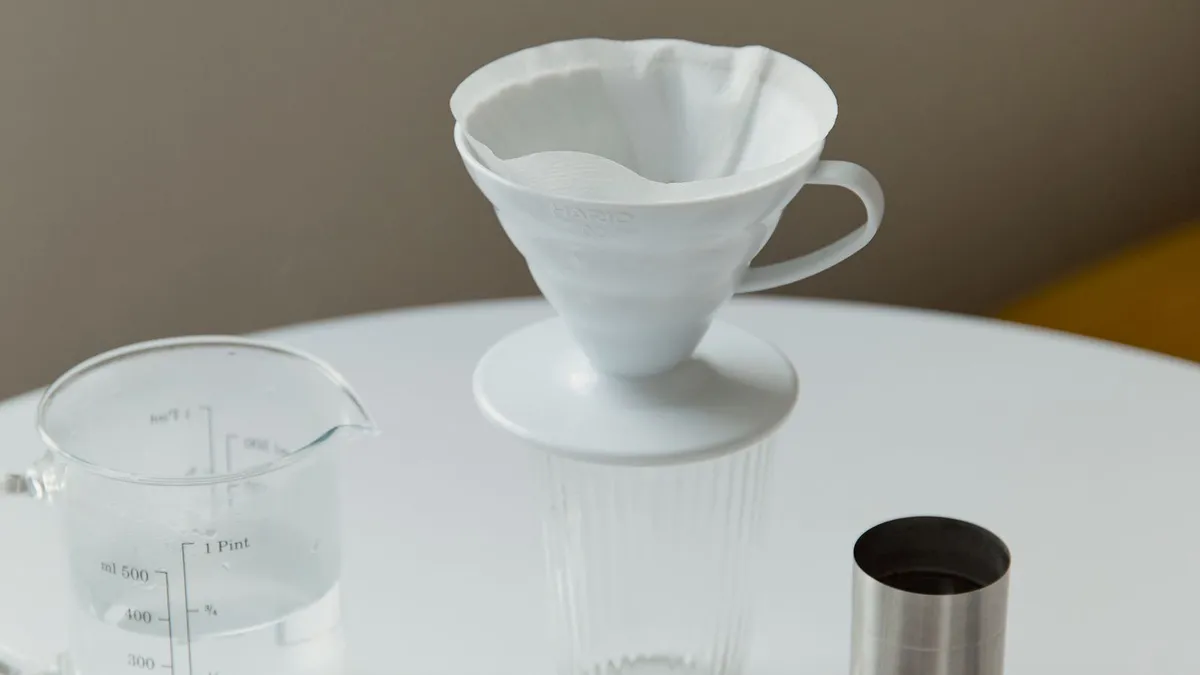
Don't buy everything at once. It's tempting, especially late at night with a shopping cart open, but the smarter move is a simple, complete setup you actually use for a few weeks. Then you upgrade whichever piece is holding you back, which is usually the grinder. Below are three kits (budget, mid-range and all-in), what each piece does, and the maker specs and current Amazon listing behind every product.
PourOverPro is reader-supported. As an Amazon Associate we earn from qualifying purchases. Product details come from each maker's specs and the Amazon listing; we don't lab-test products.
- Most beginners: the budget kit (Hario V60 Plastic 02, TIMEMORE Chestnut C2S hand grinder, a gram scale, V60 02 filters and the kettle you already have).
- Brewing daily or for more than one person: the mid-range kit adds the Baratza Encore, a timer scale and a variable-temperature gooseneck.
- Upgrading later: start with the grinder and leave the dripper for last.
Some people buy the full premium setup, use it a handful of times and lose interest. Others start with a plastic cone and end up hooked. Building up slowly protects you either way. Every kit below is complete and works. The pricier ones add convenience, control and repeatability, but they won't turn careless brewing into great coffee. Fresh beans and technique matter at every level.
Budget Kit: Try Pour Over Without Overspending
Dripper: Hario V60 Plastic 02

Hario V60 Plastic Dripper, Size 02
- Size 02 brews 1-4 cups, per Hario
- Lightweight plastic body
- Pairs with Hario V60 02 paper filters
The Hario V60 Plastic 02 is a cone with spiral ribs and one large hole at the bottom. Filter in, coffee in, pour water, and gravity handles the rest. Because the hole is big, your grind and your pouring speed decide how fast it drains, which makes it a great little teacher: you'll quickly learn what each change does to the cup.
Grinder: TIMEMORE Chestnut C2S
TIMEMORE Chestnut C2S
- Manual grinder, successor to the Chestnut C2
- 38mm CNC stainless steel conical burr, double bearing
- 25g capacity, full metal body
If you're going to spend a bit more anywhere, spend it here. A burr grinder makes a more even grind than a blade grinder, and even grounds extract more evenly. Cheap electric grinders are often blade grinders, so a hand burr grinder is the usual budget route to a consistent grind. The TIMEMORE Chestnut C2S is a manual grinder with a 38mm stainless steel conical burr and a 25 g capacity per the listing, enough for one or two cups. You crank it by hand, so budget a little extra time in the morning.
Scale: Greater Goods Coffee Scale
Greater Goods Coffee Scale
- Reads in 0.1 g increments
- Count-up and count-down timer
- Silicone cover, 5.25" platform, 6 units, 3 AAA batteries included
Any kitchen scale that reads in grams will do. A coffee scale like the Greater Goods coffee scale adds 0.1 g readings and a built-in timer, so weighing and timing happen on one device. Weigh both the coffee and the water. A 1:16 ratio (one part coffee to sixteen parts water) is a common starting point inside the widely used 1:15 to 1:17 range.
Filters: Hario V60 02 Paper Filters
Hario V60 02 Paper Filters, White, 100 Count
- Sized for the V60 02 dripper
- White, oxygen-bleached paper
- 100 filters per pack
Hario's V60 02 white filters are oxygen-bleached and come in packs of 100. Rinsing the filter with hot water before the coffee goes in is a common step. It cuts down on any papery taste and warms up the dripper.
Kettle: Use What You Have
Any kettle works to start. The Specialty Coffee Association's commonly cited brewing range is about 195-205°F (90-96°C), so bring the water to a boil and let it sit briefly off the heat, or check it with a thermometer if you have one. A regular spout pours fast, so go slow and add water in small amounts. A gooseneck makes this easier, but that's a later upgrade.
What you're missing: a gooseneck kettle (helpful, not essential) and a thermometer (helpful if you want to hit a specific temperature).
What you can skip: fancy brewers, premium scales and matching accessories. This kit is all function, and it's complete.
A starting recipe: Grind 20 g of coffee medium-fine. Put a rinsed filter in the V60 and add the coffee. Pour about 40-50 g of water to wet all the grounds and let it bloom for 30-45 seconds (the coffee releases gas and puffs up, which is oddly satisfying to watch). Then pour slowly in stages up to 320 g of water total, a 1:16 ratio. A total brew time of roughly 3 to 4 minutes is a common target. Treat all of this as a starting point. Taste, then change one thing at a time: go finer if it's sour or thin, coarser if it's bitter or harsh.
If you only ever buy this kit: you have everything you need to brew good pour over every day. It's not a stepping stone. It's a complete setup.
Mid-Range Kit: For Daily Brewers
Dripper: Hario V60 or Clever Coffee Dripper
Clever Coffee Dripper, Large (Black)
- 18 oz; immersion steep, then paper-filtered drawdown
- Shut-off valve releases when set on a cup (fits cups 1.5" to 3.75" wide)
- BPA-free Tritan plastic; includes 100 filters, coaster and lid
Either one is fine. The V60 rewards pouring technique. The Clever Coffee Dripper steeps coffee and water together, then drains through a paper filter when you set it on a cup, so there's no pour to manage. Pick whichever sounds more fun to you. (The Clever link now points to the black version; we switched in Oct 2026 when the original listing went out of stock.)
Grinder: Baratza Encore
Baratza Encore (ZCG485BLK)
- 40 grind settings with 40mm conical burrs
- Range runs espresso to French press, per Baratza; best suited to filter brewing
- Front pulse button, DC motor, 1-year warranty
The Baratza Encore is an electric conical burr grinder with 40 settings. Going from hand to electric ends the daily cranking, which starts to matter a lot if you brew every day or for more than one person.
Scale: Hario V60 Drip Scale
Hario V60 Drip Scale (New Model)
- 0.1 g steps from 2-200 g, then 0.5 g and 1 g steps up to 2,000 g max, per Hario
- Built-in timer
- Auto-off after 5 minutes (not while the timer runs); 2 AAA batteries
The Hario V60 Drip Scale reads in 0.1 g steps up to 200 g (coarser above that, to a 2,000 g max, per Hario) and has a built-in timer. The listing also says it won't auto-off while the timer is running, so it won't go dark on you halfway through a brew.
Kettle: Bonavita 1L Variable-Temperature Gooseneck
Bonavita 1L Variable-Temperature Gooseneck Kettle
- Set 140-208°F in 1° steps, with 6 presets
- Holds temperature for up to 60 minutes
- 1,200 W, 304 stainless steel
The Bonavita gooseneck adds the two things a regular kettle can't give you: a narrow spout for pouring control, and variable temperature from 140°F to 208°F in 1° steps. Set it somewhere in the SCA's commonly cited 195-205°F range and it'll hold there for up to 60 minutes.
Filters
Stick with Hario V60 02 filters for the V60. The Clever Dripper comes with 100 filters in the box.
What's better than the budget kit: no more hand-cranking, more repeatable pours thanks to the gooseneck and temperature control, and weighing and timing on one scale. Used well, both kits can make a very similar cup. The difference is mostly convenience and consistency.
What you're still missing: high-end grinders, premium kettles and specialty brewers. You don't need any of them.
Where to go next: after a few months, if you want timed grinding, look at the Baratza Virtuoso+. If you want a hand grinder for travel, look at the 1Zpresso J. Both show up in the next kit.
All-In Kit: For Enthusiasts
Dripper: Fellow Stagg [X]
Fellow Stagg [X] Pour-Over Dripper
- 10 oz capacity
- Stainless steel, double-wall vacuum insulated
- Built-in ratio aid; includes 15 filters
The Fellow Stagg [X] is a 10 oz stainless steel dripper with double-wall vacuum insulation and a built-in ratio aid. It won't automatically make better coffee than a V60. It is a durable, well-designed dripper, though, and for some people a nicer brewer makes the morning routine more of a pleasure.
Grinder: 1Zpresso J (Manual) or Baratza Virtuoso+ (Electric)
1Zpresso J
- 48mm stainless steel burrs
- Internal numerical adjustment, 30 clicks per rotation
- Foldable handle, tool-free disassembly, 1-year limited warranty
Baratza Virtuoso+ (ZCG587BLK)
- 40 grind settings with conical burrs
- 40-second digital timer adjustable in 0.1-second steps
- LED-backlit grounds bin, metal top and base, 1-year warranty
The 1Zpresso J is a manual grinder with 48mm stainless steel burrs and a numbered adjustment (30 clicks per rotation), so it's easy to get back to a setting. The Virtuoso+ is an electric conical burr grinder with 40 settings and a digital timer in 0.1-second steps. It comes down to one question: do you like the ritual and portability of grinding by hand, or would you rather press a button?
Scale: TIMEMORE Basic 2.0
TIMEMORE Basic 2.0 Coffee Scale
- 0.1 g resolution up to 2 kg
- Timer plus flow-rate function
- Rechargeable 1,600 mAh battery (up to 10 hours), USB charging
The TIMEMORE Basic 2.0 adds a flow-rate function to the usual 0.1 g readings and timer, so you can see how fast you're pouring while you pour. It charges over USB and the listing rates it for up to 10 hours per charge.
Do you need it? No. A basic scale plus a timer does the same core job. Flow rate is for people who want to fine-tune their pour and repeat it exactly.
Kettle: Fellow Stagg EKG Pro
Fellow Stagg EKG Pro
- Electric gooseneck, 0.9 L capacity
- To-the-degree temperature control
- High-resolution LCD with built-in brew timer
The Fellow Stagg EKG Pro is an electric gooseneck with to-the-degree temperature control, a high-resolution LCD and a built-in brew timer. It isn't necessary (the Bonavita already handles temperature), but it puts precise control, a timer and Fellow's design into one kettle.
Filters
The Stagg [X] comes with 15 filters; check Fellow's listing for compatible replacements. If you also brew with a V60, keep a pack of V60 02 filters around.
What improves at this level: the gear is nicer to use, more precise and more repeatable. But a well-used budget kit can make a very similar cup. You're paying for workflow and enjoyment more than a different result.
What you can skip even here: the flow-rate scale (a timer scale does the core job) and the premium kettle (the Bonavita has temperature control). Mixing tiers is fine, too. Plenty of people keep a mid-range kettle and scale and put their upgrade money into the grinder.
What to Buy First If You're Upgrading
Say you've used the budget kit for a month and you're into it. What's first?
1. The grinder. An electric burr grinder like the Encore or Virtuoso+ gives you time back every single morning. If you'd rather stay manual, the step up is bigger burrs and a numbered adjustment, like the 1Zpresso J.
2. The kettle. A gooseneck gives you pouring control, and an electric variable-temperature model lets you set the water temperature directly.
3. The scale. A built-in timer is handier than timing separately, but if your basic scale works, keep using it.
4. The dripper. Dead last. A V60 or Melitta cone makes good coffee; a pricier dripper mostly changes the materials and the experience.
The Beginner Coffee Equipment Checklist
Starting out? Make sure you have these:
- Dripper (V60, Melitta cone, Clever Dripper or similar)
- Burr grinder (hand or electric)
- Scale that reads in grams
- Filters that fit your dripper
- Kettle (any kettle to start; gooseneck preferred)
- Fresh whole-bean coffee with a recent roast date
That's it. Six things. With those you can brew very good coffee, and everything else is refinement.
What Not to Buy (Even Though You'll Be Tempted)
Automatic pour over machines: they take the pour out of your hands. If you want to learn how pour over works, a manual dripper is the simpler start.
A shelf of brewers: you don't need a V60, a Melitta and a Clever Dripper on day one. Pick one and get to know it.
Pre-ground coffee: even pricey pre-ground coffee loses aroma faster than whole beans. Grind fresh.
Coffee subscriptions: not until you know what you like. Buy single bags first, ideally with a roast date printed on them.
Specialty filters: the standard filters for your dripper are all you need.
The Best Beginner Coffee Brewing Kit
For most people, it's the budget kit. Use it for a few months and see whether you like the process. If you do, upgrade the grinder first. If you don't, you haven't spent much, and you've still got a nice mug of coffee out of it.
Expensive gear won't make you love coffee. Start simple, make good coffee, and spend more once you know you want to.
The Bottom Line: A budget kit with fresh beans, a scale and good technique can make coffee as good as a premium kit used carelessly. Technique and beans usually matter more than what the gear cost.
Related Reading
- How to Choose Coffee Beans for Pour Over
- Coffee to Water Ratio: A Simple Guide for Every Brew Method
- Water Temperature for Coffee: What Range to Use and Why
- Best Budget Coffee Makers
- The Best Gifts for Coffee Lovers